THE THEORY AND PRACTISE OF FROST
FIGHTING[1]
BY ALEXANDER McADIE
BOTCH PROFESSOR OF METEOROLOGY, HARVARD UNIVERSITY
ONLY in recent years have aerologists given much attention to the
slow-moving currents of the lower strata of the atmosphere.
These differ greatly from the whirls and cataracts of both low and high
levels which we familiarly know as the winds. The upper and larger air
streams play a part in the formation of frost, and we do not underestimate
their function; but primarily it is a slow surface flow, almost a
creeping of the air near the ground, which controls the temperature and
is all-important in frost formation. So important is it that the first law
of frost fighting may be expressed as follows:
Where air is in motion and where there is good circulation, frost
is not so likely to occur as where the air is stagnant.
In other words frost in the ordinary meaning of the word is a problem
in local air drainage is true that there are times when with thorough
ventilation and mixing of the air strata the temperature will fall
rapidly and damage from frost result; but such conditions are perhaps
more fittingly described as cold waves or freezes, as distinguished from
frosts. Thus, in California during the first week of January, 1913, when
there was much air movement, the citrus fruit crop was damaged to the
extent of $20,000,000. The condition is generally referred to as a frost,
but it was quite different from the usual frost conditions in that section.
It is, however, interesting to note that improved frost-fighting devices
were used with much success and the total savings aggregated about
$25,000,000. The orange growers also had the benefit of accurate forecasts
and expert advice and were thus able to provide fuel and labor in
advance. Passing over at present the larger disturbances, we shall consider
only the frosts of still nights. And it should not be forgotten that
the accumulated losses of these frosts may equal the losses of the individual
freezes, for the latter occur at long intervals, while the quiet frosts
of the early fall and the late spring are recurrent, destroying flowers,
fruits and tender vegetation in many sections, year after year.
Air may flow in any direction, but attention has been centered more
upon the flow in a horizontal than in a vertical direction. Thus none
of the wind instruments used at Weather Bureau stations gives any
record of the up and down movement of the air. In frosts of the usual
type this vertical displacement is all-important. True, there may be
brought into the district, by horizontal displacement, large masses of
cold air and the temperature thus materially lowered; but the marked
inversion of temperature occurs only when these horizontal currents or
winds are lulled. On windy nights, as is well known, there is less likelihood
of frost than on quiet nights, because of the thorough mixing of
the air vertically. There is then no tendency for stratification and the
formation of levels of different temperature, followed by low surface
temperature.
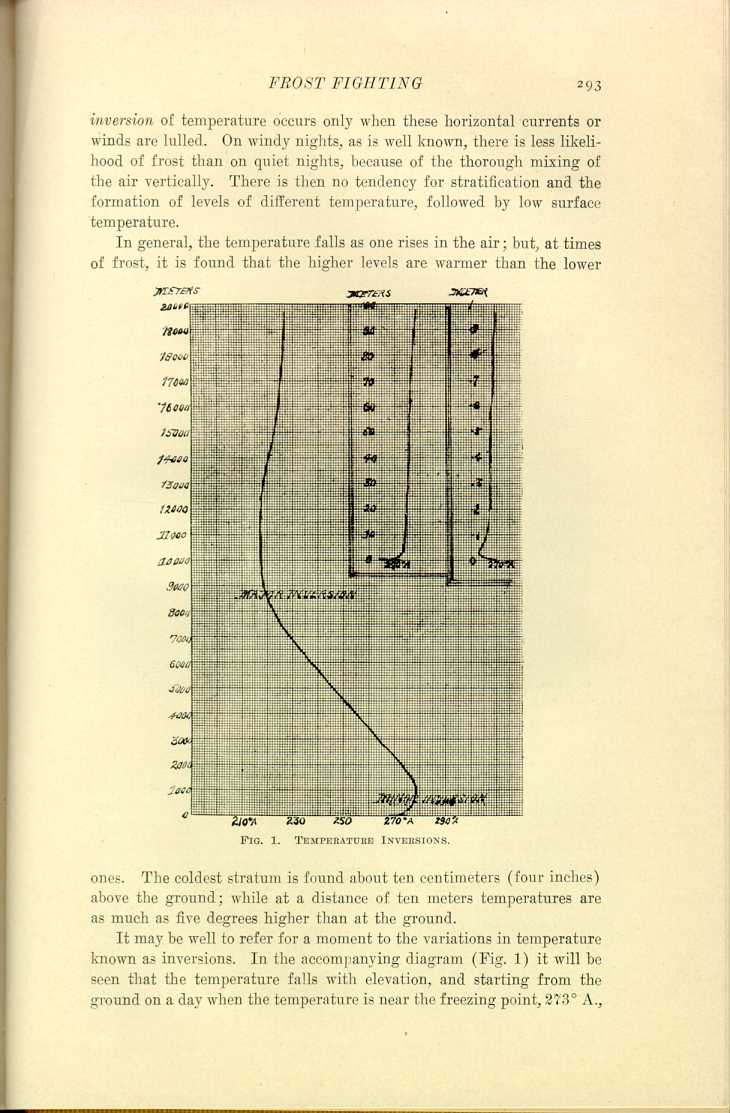
In general, the temperature falls as one rises in the air; but, at times
of frost, it is found that the higher levels are warmer than the lower
ones. The coldest stratum is found about ten centimeters (four inches)
above the ground; while at a distance of ten meters temperatures are
as much as five degrees higher than at the ground.
It may be well to refer for a moment to the variations in temperature
known as inversions. In the accompanying diagram (Fig. 1) it will be
seen that the temperature falls with elevation, and starting from the
ground on a day when the temperature is near the freezing point,
273° A.,
one finds at a height of seven thousand meters a fall of about forty
degrees. It is not easy to represent on a single diagram the variation in
detail and therefore we have divided the air column into three parts, the
scales being as one to a hundred.
The right-hand diagram shows the gradual rise in temperature for
a height of one meter and the peculiar inversion that occurs a few
centimeters above the ground. Unfortunately it is in this layer where
detailed temperature observations are most needed that our instruments
are least satisfactory. Ordinary thermometers can not be relied
on for such small differences and the exploration of this stratum by
self-recording instruments is difficult. In the middle diagram is shown
the temperature gradient at times of frost, from the ground to a height
of one hundred meters. It will be seen that at a height of fifty meters
the temperature may be ten degrees higher; and in general the rise
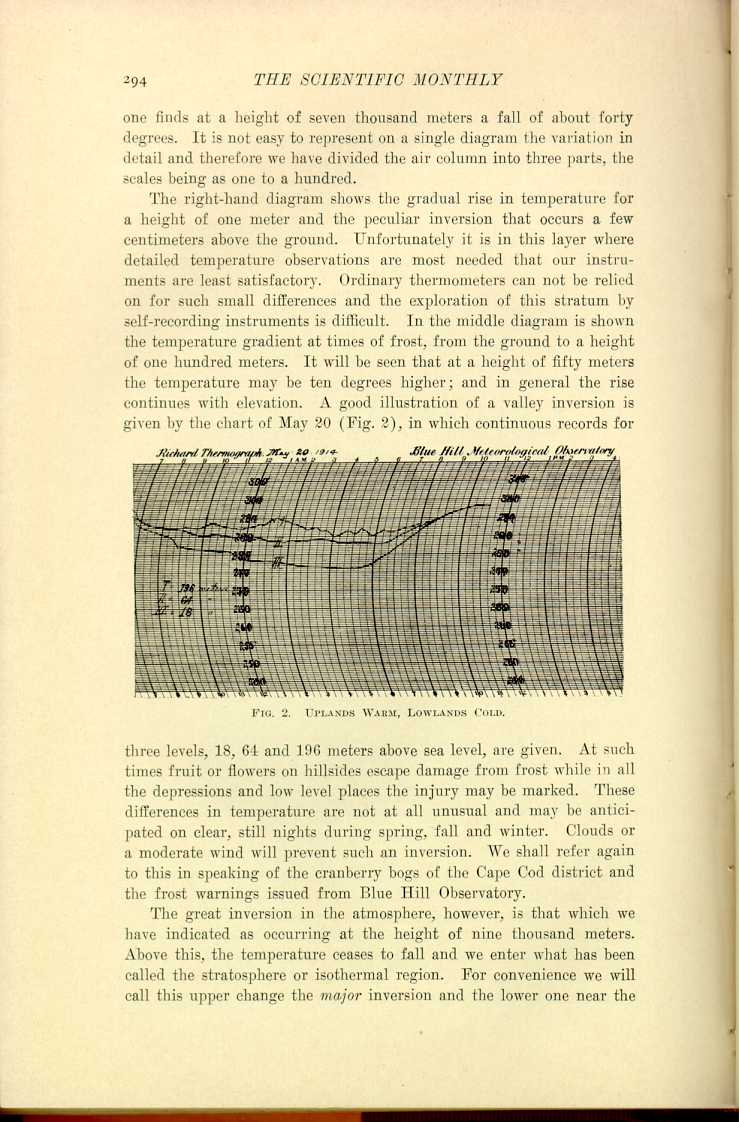
continues with elevation. A good illustration of a valley inversion is
given by the chart of May 20 (Fig. 2), in which continuous records for
three levels, 18, 64 and 196 meters above sea level, are given. At such
times fruit or flowers on hillsides escape damage from frost while in all
the depressions and low level places the injury may be marked. These
differences in temperature are not at all unusual and may be anticipated
on clear, still nights during spring, fall and winter. Clouds or
a moderate wind will prevent such an inversion. We shall refer again
to this in speaking of the cranberry bogs of the Cape Cod district and
the frost warnings issued from Blue Hill Observatory.
The great inversion in the atmosphere, however, is that which we
have indicated as occurring at the height of nine thousand meters.
Above this, the temperature ceases to fall and we enter what has been
called the stratosphere or isothermal region. For convenience we will
call this upper change the major inversion and the lower one near the
ground the
minor inversion. In some ways we know more about the
former than the latter. Strictly speaking, the minor inversion is the
chief factor in determining local climate since it controls night and
early morning temperatures and in large measure the early or late
blooming of flowers and ripening of fruits.
Ordinarily cold air falls to the ground; but not always, for under
certain conditions cold, heavy air may actually rise, displacing warm,
lighter air. But such conditions can be explained and there is no
contradiction of the fundamental law that if acted on only by gravity, cold
air, being denser, will settle to the ground and warm air, being lighter,
will rise. And there must be a certain relation between the height of
the level from which the cold air falls and the level to which the warm
air rises. In other words, we have to apply the laws of falling bodies
since a given mass of air, although invisible, is matter and as subject to
gravity as a cannon ball.
One of Galileo's most ingenious experiments consisted in swinging a
pendulum and then by means of a nail driven in various positions intercepting
the swing. He found that the bob always rose to the same level
whatever circuit it was forced to take. But Galileo did not know what
every schoolboy to-day knows, that air exerts pressure and is subject to
physical processes like other matter, else he would certainly have given
to the world a delicate air pendulum; and devised experiments on the
movement of air that would have opened men's eyes to the fascinating
flow and counter-flow of the air, even on a seemingly still night, one
favorable for the formation of frost.
The problem of the moving air mass, however, is more complicated
than it looks. For with the air is mixed a quantity of water vapor. In
a strict sense they are independent variables, and the view set forth in
most text-books that air has a certain capacity for water vapor is
misleading. We seldom meet with pure, dry air. A cubic meter of such a
gas mixture would weigh 1,247 grams, at a temperature of 283° A.
(50° F.). If chilled ten degrees, that is, to the freezing point of water,
it would weigh 46 grams more. So that by cooling, air becomes denser
and heavier. A cubic meter of a mixture of air and water vapor at
saturation, at the first temperature above mentioned weighs only 1,242
grams, or five grams less, and if this were cooled ten degrees the mixture
would weigh three grams less than the same volume of pure dry air. We
see that in each case the mixture of air and water vapor weighs less than
the air by itself. One would think that by adding water vapor which,
while light, still has weight, the total weight would be the sum of both.
It really is so, notwithstanding the above figures, and the explanation of
the puzzle is that there was an increase in pressure with expansion, so
that the volume of the air and saturated vapor was greater than one cubic
meter. Since then a cubic meter of air and saturated vapor weighs less
than a cubic meter of dry air at freezing temperature, speaking generally,
we may expect moist air to rise and dry air to fall. Consequently,
if in addition to falling temperature there is also a drying of the air, we
shall have an accelerated settling or falling of cold dry air to the ground,
which of course favors the formation of frost. The water vapor plays
also another rôle besides that of varying the weight per unit volume.
The heat received by the ground consists of waves of a certain wavelength;
but the heat re-radiated by the ground consists of waves of
longer wave-length, and these so-called long waves (12 thousandths of a
millimeter) are readily absorbed by water vapor. Thus water vapor acts
like a blanket and holds the heat, preventing loss of heat by radiation to
space. Further on we shall speak of the high specific heat of both water
and water vapor as compared with air and show the bearing of this in
frost fighting; but at present we may from what precedes formulate the
second law of frost fighting as follows: "Frost is more likely to occur
where the air is dry than where it is moist.'' It is also true that a dusty
atmosphere is less favorable for frost than a dust-free atmosphere. Thus
we may generalize and say that whatever favors clear, still, dry air
favors frost. The theory of successful frost fighting then is to interfere
with or prevent these processes which as we have seen facilitate cooling
close to the ground. In what way can this best be done?
The most natural way would be by conserving the earth's heat, which
could be accomplished by covering plants with cloth, straw, newspaper,
or perhaps better still, modern weather-proof sheeting, or in still
another way by a cover of moistened dense smoke, generally called a
smudge. A second method would be by means of direct application of
heat; and this is accomplished in orange groves by means of improved
orchard heaters. Large fires waste heat and are neither economical nor
effective. A third method would be based upon a mixing of the air
strata, thus getting the benefit of the warmer higher levels. Fourth,
advantage might be taken of some agency such as water or water vapor,
having a high specific heat. Finally, if the crop is of a certain character
such as the cranberry, it will be found advisable to use sand, to drain and
clean, here again making use of the specific heat of some intermediary.
And, furthermore, any one of these methods may be combined with some
other method.
Regarding the first method, that of covers, it may be said that the
practice goes back to the early husbandmen; but only in the last few
years has the true function of the cover been properly interpreted and
we are still far from obtaining maximum efficiency. Nor is there yet a
suitable, scientific cover available. Any medium that interferes with
loss of heat through free radiation before and after sunset is a cover.
The best type of cover is a cloud; and clouds, whether high or low, are
good frost protectors. On cloudy nights there is little likelihood of
frost; and when we can bring about the formation of a layer of condensed
water vapor we can practically eliminate frost. We have mentioned
above the fact that the earth radiates the heat it has received not in the
same but in longer wave-lengths perhaps three times as long. These are
easily trapped and held by the vapor of water. Furthermore, the rate of
radiation is a function of the absolute temperature and so the rapidity
of loss depends somewhat upon the heat received. Therefore the cover
should be used as early in the afternoon as possible, that is just before
sunset. Aside from the water cover or vapor cover there are cheap
cloth screens, fiber screens and in some places lath screens.
The second method, that of direct heating, has met with much success
in the orange groves of California and elsewhere. Modern heating and
covering methods date from experiments begun in 1895. A number of
basic patents granted to the writer in this connection have been dedicated
to the public. At the present time there are on the market some twenty
forms of heaters, which have been described with more or less detail in
farm journals and official publications. It is not necessary to refer to
them further here. The fuel originally used was wood, straw and coal,
but these are now supplanted by crude oid or distillate.
It has also been
seriously proposed to use electric heaters; also to use gas in the groves.
With modern orchard heaters properly installed and handled, there is
no difficulty in raising the temperature of even comparatively large tracts
five degrees and maintaining a temperature above freezing, thus preventing
refrigeration of plant tissue.
The third method, that of utilizing the heat of higher levels by mixing,
has not yet been commercially developed; but the methods of applying
water, either in the spraying of trees or the running of ditches or
the flooding of bogs, together with methods of sanding, cleaning; and
draining, have all been proved helpful. Methods available and most
effective in one section may not necessarily be effective in another section
or with different crop requirements. Certain devices most effective
in the groves of California may not answer in Florida or Louisiana because
of entirely different weather conditions. In the Gulf coast states
where water is available it may be advantageously used to hold back
ripening and retard development until after the cold waves of middle
and late February have passed, whereas in the west coast sections conditions
are very different, water having a definite value and the critical
periods coming in late December or early January.
In what precedes stress has been laid chiefly upon the fall of
temperature and the congelation of the water vapor. There is, however, another
important matter connected with injury to plant tissue, and that
is the rise in temperature after the frost. A too rapid defrosting may
do considerable damage where no damage was originally done by the low
temperature. It is in this connection that water may be used to great
advantage. Water, water-vapor and ice have, compared with other substances,
remarkably high specific heats. If the specific heat under constant
pressure of water be taken as unity, that of ice is 0.49; of water-vapor
0.45 and of air 0.24. Or in a general way we may say that water
has four times the capacity for heat that air has. Therefore it is apparent
that water will serve excellently to prevent rapid change in temperature.
This is important at sunrise and shortly after when some portion
of the chilled plant tissue may be exposed to a warming sufficient to
raise the temperature of the exposed portion ten degrees in an hour.
The latent heat of fusion of ice is 79.6 calories and the latent heat of
vaporization of water is nearly 600 calories (a gram calorie is the amount
of heat that will raise the temperature of a gram of pure water one
degree) or in exact terms from 273° A. to 274° A. Therefore in the
process of changing from solid to liquid to vapor, as from ice to water
to vapor, there is a large amount of heat required. The latent heat serves
to prevent fall in temperature and also serves to retard a too rapid rise.
This does not mean, as is generally assumed, that the air will be warmed,
but it does mean a retardation of temperature change. And it is essential
that the restoration of the tissues and juices to their normal state
be accomplished gradually, neither too rapidly nor yet too slowly.
There is probably an optimum temperature for thawing or defrosting
frozen fruits and flowers. Finally the temperature records as ordinarily
obtained need careful interpretation. It may be that the freezing point
of liquids under pressure in the plant cells or exposed to the air through
the stomata is not the same as in the free air. It is unfortunate too that
in most places data showing temperatures of soil, plant and air are of
doubtful character. A word of warning may be given against the too
ready acceptance of Weather Bureau records made in cities and on the
roofs of buildings. Garden and field conditions vary greatly from these.
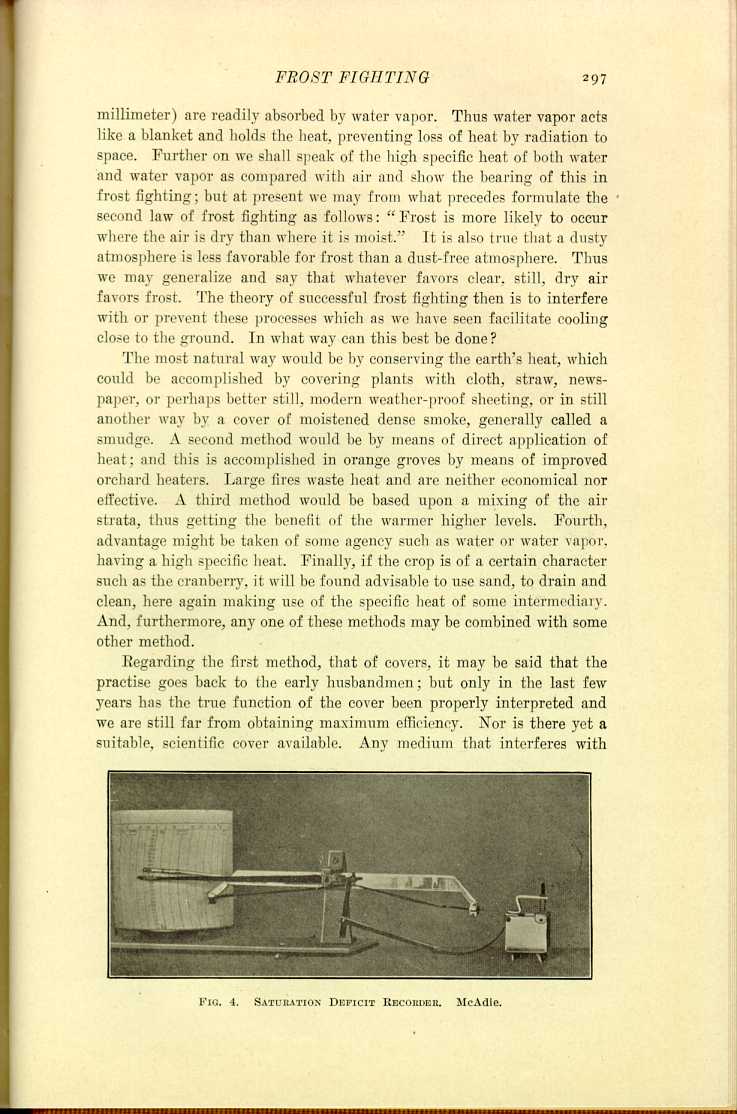
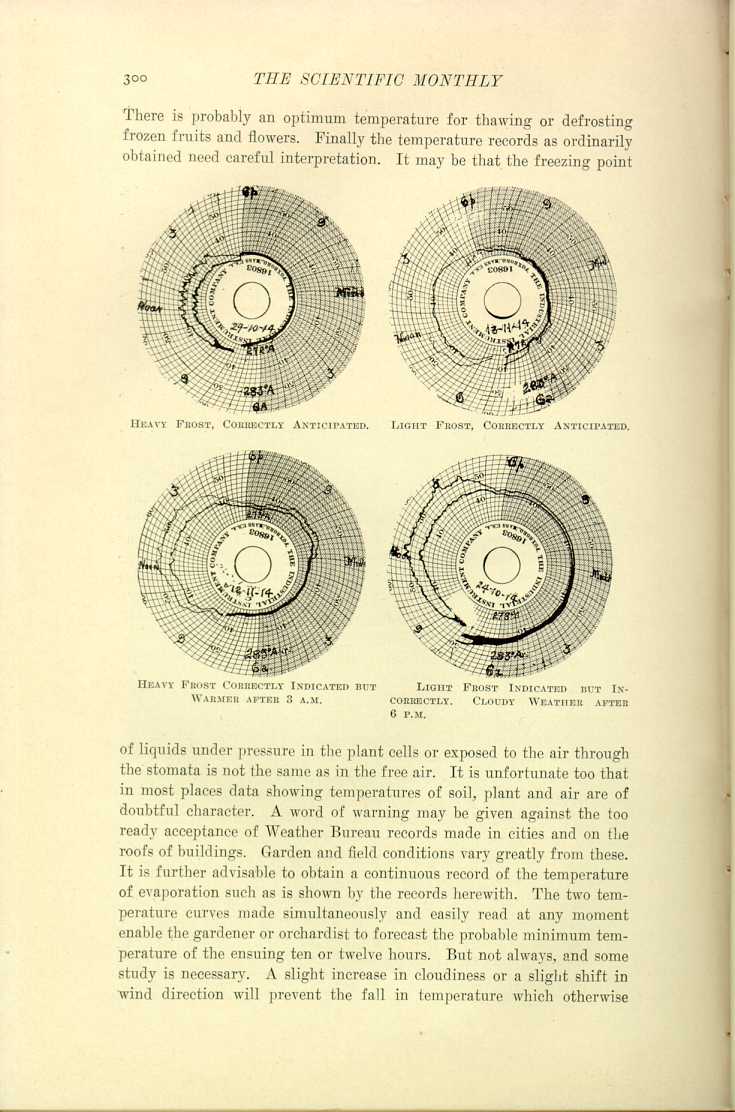
It is further advisable to obtain a continuous record of the temperature
of evaporation such as is shown by the records herewith. The two
temperature curves made simultaneously and easily read at any moment
enable the gardener or orchardist to forecast the probable minimum
temperature of the ensuing ten or twelve hours. But not always, and some
study is necessary. A slight increase in cloudiness or a slight shift in
wind direction will prevent the fall in temperature which otherwise
seemed probable. With a persistent inversion of temperature there is
sometimes an increasing absolute humidity.
SUMMARY
The problem is many sided and we must consider the motion of the
air vertically as well as horizontally. Air gains and loses heat chiefly by
convection, and any gain or loss by conduction may be neglected. The
plant gains heat by convection, radiation and perhaps by conduction of an
internal rather than surface character. The ground gains and loses heat
chiefly by radiation. But the whole process is complicated and may not
even be uniform. Frosts generally are preceded by a loss of heat from
the lower air strata, due to convection and a horizontal translation of the
air. Then follows an equally rapid and great loss of heat by free radiation.
There are minor changes such as the setting free of heat in condensation
and the utilization in evaporation, but these latent heats are of
less importance than the actual transference of the air and vapor and the
removal of the latter as an absorber and retainer of heat.
Frosts are recurrent phenomena reasonably certain to occur within
given dates, and, as pointed out above, the cumulative losses are
considerable. Methods of protection to be serviceable must be available
for more than one occasion, for there is no profit in saving a crop on one
night and losing it on the succeeding night. But the effort is worth
while. Consider that the horticulturist regularly risks the labor of many
months on the temperatures of a few hours. An efficient frost fighting
device is in a way the entering wedge for solving problems of climate
control. One may not take a crop indoors, it is true, but there is no
valid reason, in the light of what has been already accomplished, why at
critical periods which may be anticipated, the needed volume of surface
air may not be sufficiently warmed; and the losses which have heretofore
been considered inevitable be prevented.
[1.]
Some of the instruments used were obtained through a
grant from the Elizabeth Thompson Science Fund.