49. Creatures in Pennsylvania
BY GABRIEL THOMAS (1698)
THE natives of this country are very charitable to one
another. The lame and the blind amongst them live as well
as the best. They are also very kind and obliging to the
Christians.[181]
In person they are ordinarily tall, straight, and well
formed. Their tread is strong, and they generally
walk with the chin high up. Of complexion, they are
dark, but in features they are gypsy-like, greasing
themselves with bear's fat, and using nothing to protect them
against the injuries of the sun and weather, so their skins
cannot fail to be dark. Their eyes are small and black. They
have pleasing faces.
Their language is dignified and polite. But they use
few words. One word serves in the place of three. The
language is sweet, and of noble sound.
Take here a specimen:—
Hodi hita nee Cuska a peechi, nee, machi
Pennsylvania huska dogwachi, Keshow a peechi
Nowa, huska haly, Chetena Koon peo.
This is the English of it:—
Farewell friend, I will very quickly go to
Pennsylvania, very cold moon will come presently,
And very great hard frosts will come quickly.
As soon as their children are born, they wash them
in cold water, especially in cold weather. To harden them
and make them courageous, they plunge them in the river.
The children find their feet early; usually at nine months
they can walk alone.
The boys fish till they are fifteen years of age, then hunt.
When they have given a proof of their manhood by getting
together a large lot of skins, they may marry. This is usually
at the age of seventeen or eighteen. The girls stay with their
mothers, and help to hoe the ground, plant corn, and carry
burdens. They marry when they are about thirteen or
fourteen years of age.
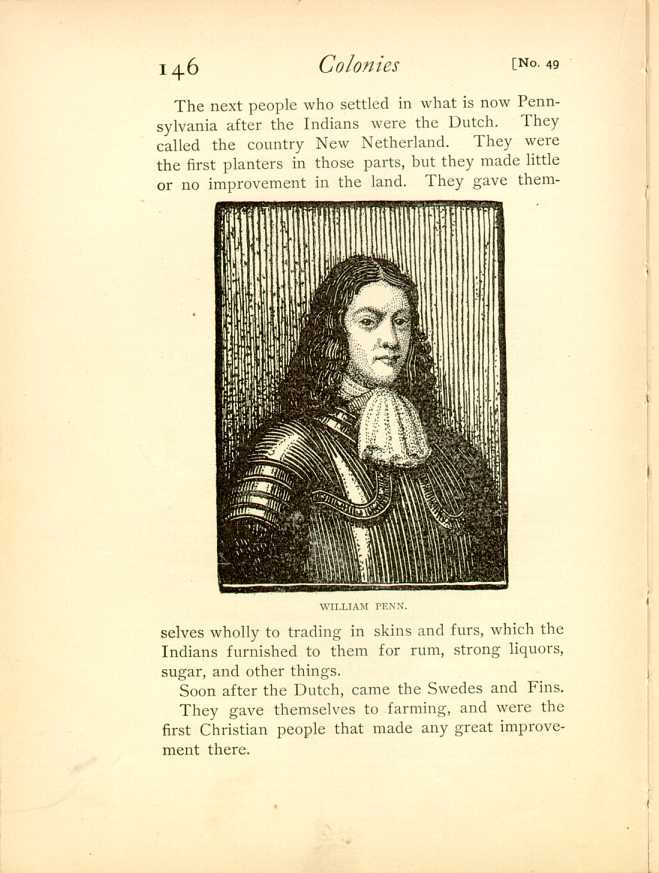
The next people who settled in what is now Pennsylvania
after the Indians were the Dutch. They called the country
New Netherland. They were the first planters in those parts,
but they made little or no improvement in the land. They
gave themselves
wholly to trading in skins and furs, which the Indians
furnished to them for rum, strong liquors, sugar, and other
things.
Soon after the Dutch, came the Swedes and Fins.
They gave themselves to farming, and were the first
Christian people that made any great improvement there.
The air in this region is very fine and pleasant, and healthful.
The heavens are serene, seldom cloudy, and somewhat like
the better part of France. The corn harvest is ended before
the middle of July, and most years they have between twenty
and thirty bushels for every bushel they sow.
There are several sorts of wild beasts good for trade and for
food. Panthers, wolves, deer, beaver, otter, hares, musk-rats,
minks, wild-cats, foxes, raccoons, rabbits, and opossums are
to be found. The possum is a strange creature, having a
pouch to shelter her young ones. By this means she saves
them from danger, when anything comes to disturb them.
There are also bears, and some wolves. But they are now
pretty well destroyed by the Indians for the sake of the
reward given them by the Christians for so doing. Here is
also that wonderful creature, the flying squirrel! It has a kind
of skinny wings, almost like those of the bat. It has the same
kind of hair and color as the common squirrel, but is much
smaller.
I have myself seen it fly from one tree to another in the woods.
But how long it can keep on flying is not exactly known. There are in
the woods many red deer. I have bought of the Indians a whole deer skin
and all for a little gunpowder.
The venison is excellent food, most delicious, far exceeding
that of Europe. This is the opinion of most careful and
observing people.
There are vast numbers of other wild creatures, such as the
elk and buffalo. All of these beasts, birds, and fish, are free
to any one who will shoot or take them away. There is no
hindrance or opposition whatever.
There are among other things various sorts of frogs.
The bull-frog makes a roaring noise hardly to be
distinguished from that of the beast from which it takes its
name.
There is another sort of frog that crawls up to the tops of
trees.[182] There it seems to imitate the
notes of several birds. There are many other strange and different
creatures.
Bees thrive and increase wonderfully in that country. The Swedes
often get a great supply of them in the woods, where they are free to
anybody. Choice honey is sold in the capital
city[183] for five pence a pound. Wax is also
plentiful and cheap; they have a considerable trade in it.
I must needs say, even the present encouragements are very
great and inviting. Poor people, both men and women, of all
kinds, can here get three times the wages for their labor that
they can in England.
The Christian children born here are generally fine-looking
and beautiful to behold. In general they are seen to be
better-natured, milder, and more tender-hearted than those
born in England.
[[181]]
Christians = Europeans.