

 | Colonial Children |  |
46. The First Settlement of Massachusetts
BY EDWARD JOHNSON (1628)
THESE new-comers were a supply of servants from England sent over in 1628 to provide against the wants of a lonely wilderness. Among them came over a mixed crowd of people, by whom little was done. But the much honored Mr. John Endicot came over with them to govern. He was a good person to begin this wilderness work, for he was courageous, bold, and fearless; yet sociable and of a cheerful disposition. He could be loving or austere as occasion demanded.
The place picked out by this people for a settlement was in the midst of the outstretched arm of Cape Ann. Here they began to build a town which is called Salem.
After some little time they found out how insignificant were the neighboring Indians, and the boldest among the English people gathered in different places which they began to take up for their own. Those that were sent over as servants had a great desire to see the new sights in the new world, and
Those that came over as their own masters had but little food left. Most of them began to regret coming when beer and corn began to fail. The poor Indians could not relieve them for they were obliged to eke out their own food with acorns.
What added to the unhappiness of the settlers was the thought that the ditch between England and their new place of abode was so wide that they could not leap over with a leaping-stick.[169] Yet some delighted their eye with the novelty of things about them; and they kept thinking of the new discoveries they would make when spring came. They managed to get through the winter's cold by keeping near the fireside, and found fuel enough groaning at their very doors. They smoked burned tobacco with all the comfort they could.
They talked, between one while and another, of the great progress they would make after the summer's sun had changed the earth's white furred gown into a green garment.
In the year 1629 there came over three godly ministers. This was to strengthen the faith of the settlers in meeting difficulties. Now although the number of the faithful people of Christ was small, yet their longing desire to gather themselves into a church was very great. The church of Christ being thus begun, the Lord in His tender mercy caused it to increase and be fruitful.
And now behold several other regiments of the soldiers of Christ, shipped for His service in the western world.[170] Their difficulties were many and mournful. The billows were high and angry, covering
On the twelfth day of July or thereabouts, 1630,
these soldiers of Christ first set foot on the western end of the
world. There they arrived in safety, men, women, and
children. On the north side of the Charles River they landed,
near a small island called
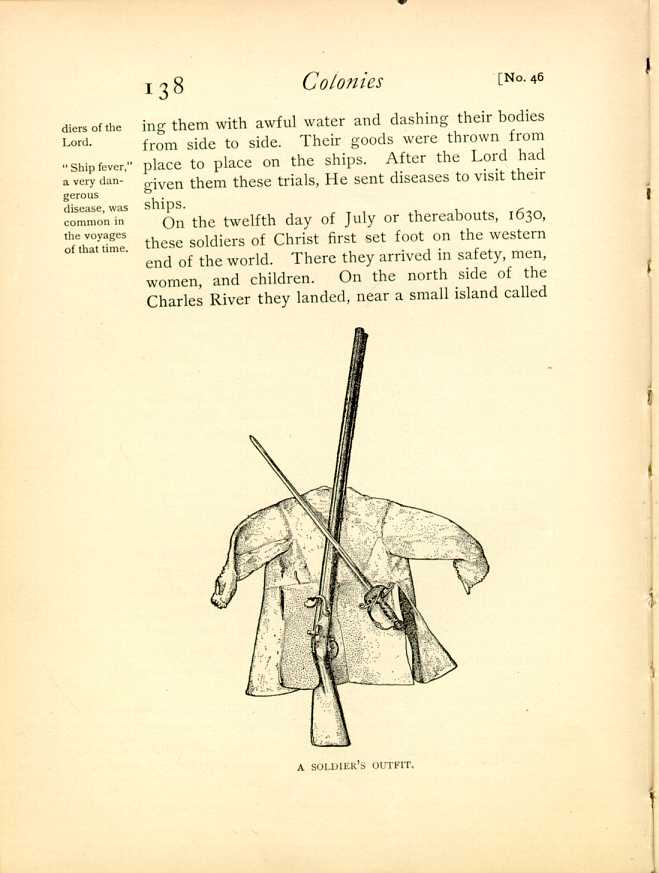
A SOLDIER'S OUTFIT.
[Description: Black and white illustration of a shirt, musket, and
sword.]
The first court was held aboard the ship Arabella. The much honored John Winthrop was chosen governor for the remainder of that year, 1630. The worthy Thomas Dudley was chosen deputy governor.
Then sore sickness fell upon the people, so that in almost every family mourning and sorrow was heard; and they had no fresh food to strengthen them. Yet it was wonderful to see with what Christian courage these soldiers of Christ persevered amidst all calamities.
Soon they had formed other churches and towns. The fourth church was seated at Boston, which became the central town and largest city of this wilderness. The form of this town is like a heart. It is naturally situated for fortifications. It has two hills on the front part of it, facing the sea. One is well fortified with heavy cannon. The other has a very strong battery built of whole timber and filled with earth.
At the bottom of these hills lies a great bay on which this town is built.[173] It is over-topped by a third hill.[174] From all three of these overtopping towers a constant watch is kept to foresee the approach of any danger from strange enemies. Each hill is furnished with a beacon and land guns. By their redoubled echoes these give notice of any danger to all their sister towns.
The buildings of this city are beautiful and large. Some are pleasingly built of bricks, tiles, stone, and slate. They are placed in an orderly fashion upon
| Colonial Children | |