

 | CHAPTER I: INTRODUCTORY—THE USE OF BOOKS IN EARLY IRISH
MONASTERIES Old English libraries; the making, collection and use of books during the middle ages |  |
4. § IV
Our account of the work accomplished by the Irish monks would be incomplete without reference to their writing, illuminating, and book-economy, the relics of which are so finely rare.
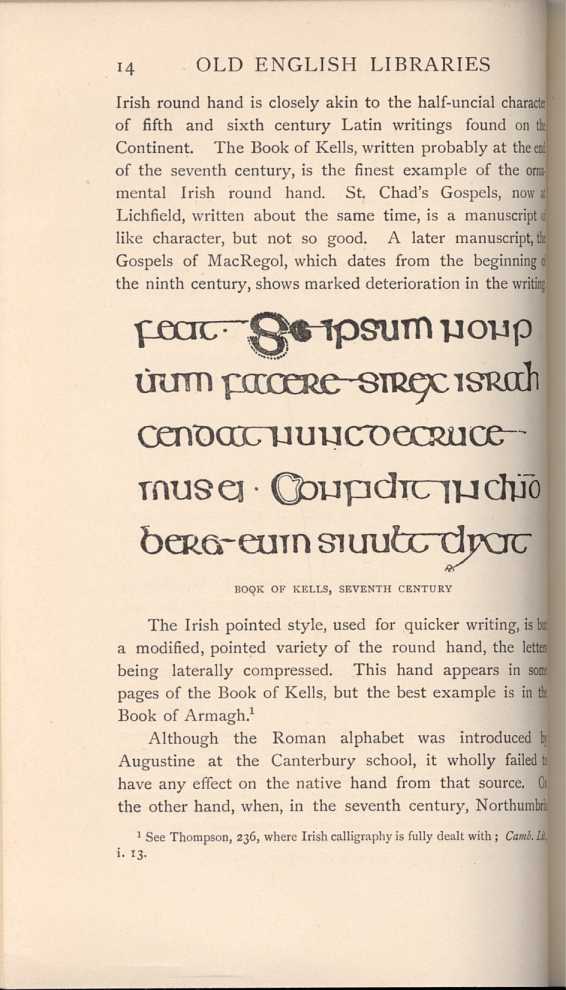
The old Irish runes gave place slowly to the Roman alphabet, which came into use, as we have already observed, after St. Patrick's mission. This new writing was in two forms—round and pointed—but both were derived from the Roman half-uncial style. The clear and beautifully-shaped
 [Description: BOOK OF KELLS, SEVENTH
CENTURY]
[Description: BOOK OF KELLS, SEVENTH
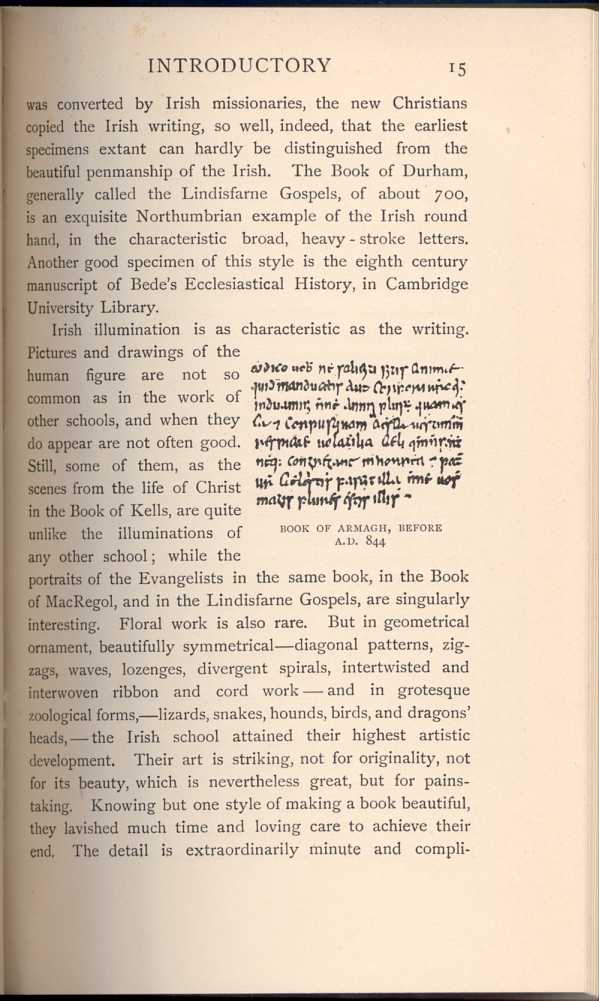
CENTURY]The Irish pointed style, used for quicker writing, is but a modified, pointed variety of the round hand, the letters being laterally compressed. This hand appears in some pages of the Book of Kells, but the best example is in the Book of Armagh.[1.43]
Although the Roman alphabet was introduced by Augustine at the
Canterbury school, it wholly failed to have any effect on the native
hand from that source. On the other hand, when, in the seventh century,
Northumbria
 [Description: ILLUMINATED PAGE OF THE BOOK OF
KELLS]
[Description: ILLUMINATED PAGE OF THE BOOK OF
KELLS]
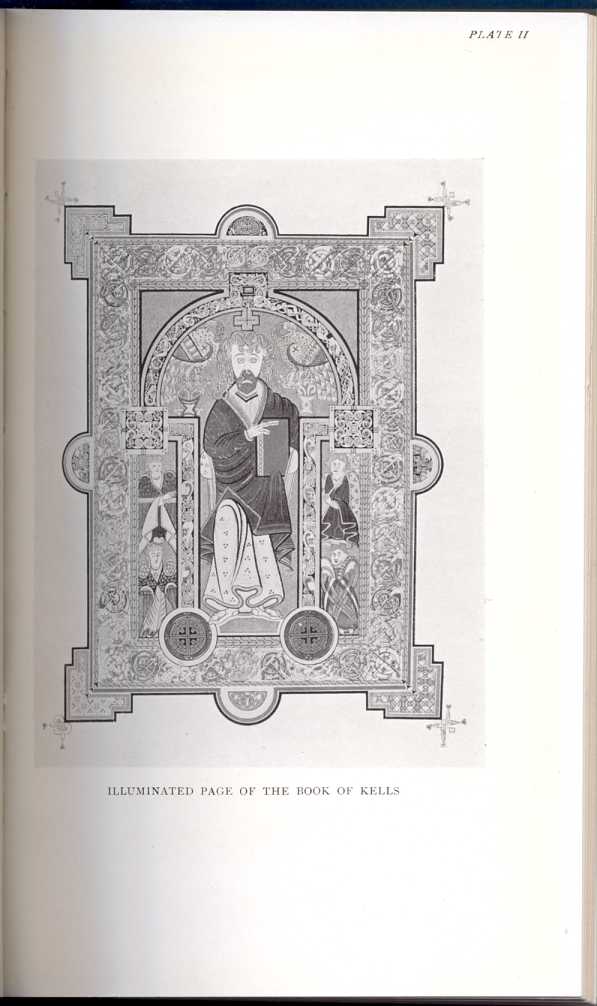
Irish illumination is as characteristic as the writing. Pictures
and drawings of the human figure are not so common as in the work of
other schools, and when they do appear are not often good. Still, some
of them, as the scenes from the life of Christ in the Book of Kells, are
quite unlike the illuminations of any other school; while the
 [Description: BOOK OF ARMAGH, BEFORE
A. D. 844]
[Description: BOOK OF ARMAGH, BEFORE
A. D. 844]
Of intricate geometrical ornament and grotesque figures, the illumination representing the symbols of the Four Evangelists (fo. 290) of the Book of Kells is perhaps the best example. Of divergent spirals and interlaced ribbon work the frontispiece of St. Jerome's Epistle in the Book of Durrow affords notable examples. Two of the peculiar features of Irish decoration—the rows of red dots round a design and the dragon's head—appear in the earliest, or nearly the earliest, Irish manuscript extant, namely, the Cathach Psalter, now in the Museum of the Royal Irish Academy. Whether the essential and peculiar features of this ornamentation are purely indigenous, as Professor Westwood contends, or whether they are of Gallo-Roman origin, as Fleury argues, is a moot point, calling for complicated discussion which would be out of place here.
The amount of illumination in the existing manuscripts varies,
but the pages chosen for illuminating are nearly always the same. In the
Book of Kells the illuminations consist of three portraits of the
Evangelists, three scenes from the life of Christ, three combined
symbols of the four Evangelists, eight pages of the Eusebian canons, and
many
 [Description: THE SHRINE OF THE CATHACH PSALTER
ELEVENTH CENTURY]
[Description: THE SHRINE OF THE CATHACH PSALTER
ELEVENTH CENTURY]
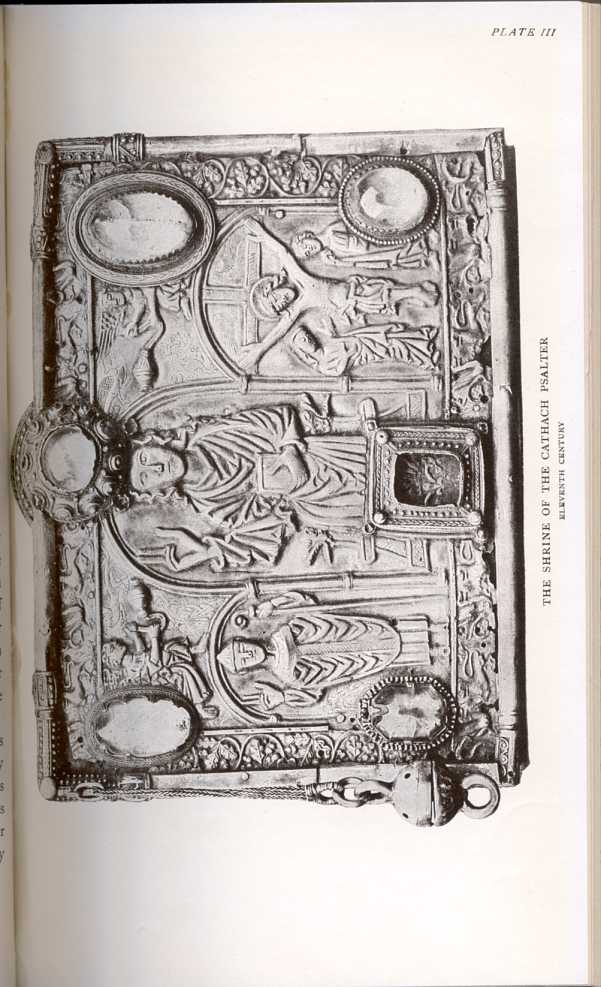
The oldest Irish manuscript in existence is probably the Domnach Airgrid, or manuscript of the Silver Shrine, also called St. Patrick's Gospels. Dr. Petrie believed the Domnach to be the identical reliquary given by St. Patrick to St. Mac Cairthinn, when the latter was put in charge of the see of Clogher, in the fifth century. "As a manuscript copy of the Gospels apparently of that early age is found with it, there is every reason to believe it to be that identical one for which the box was originally made."[1.44] But both case and manuscript are now held to be somewhat later in date. Another very early manuscript is the sixth century fragment of fifty-eight leaves of a Latin Psalter, styled the Cathach or "Battler." For centuries this fragment has been preserved in a beautiful case as a relic of Columba; as, indeed, the actual cause of the dispute between Columba and Finnian of Moville.
| CHAPTER I: INTRODUCTORY—THE USE OF BOOKS IN EARLY IRISH
MONASTERIES Old English libraries; the making, collection and use of books during the middle ages | |