

 | CHAPTER I: INTRODUCTORY—THE USE OF BOOKS IN EARLY IRISH
MONASTERIES Old English libraries; the making, collection and use of books during the middle ages |  |
3. § III
Most of the references we have made above belong to the sixth and seventh centuries, usually regarded as the best age of Irish monachism. But the Irish enjoyed their reputation unimpaired for a long time. Just before and after the Northmen descended on their land in 795, we find them making their mark abroad, not so much as missionaries but as scholars and teachers.[1.28]
A few instances will suffice. "The Acts of Charles, written by a monk of St. Gallen late in the ninth century, tells us of `two Scots from Ireland,' who `lighted with the British merchants on the coast of Gaul,' and cried to the crowd, `If any man desireth wisdom, let him come unto us and receive it, for we have it for sale.' They were soon invited to the court of Charles. One of them, Clement, partly filled the place of Alcuin as head of the palace school." [1.29] His reputation soon became widespread, and the abbot of Fulda sent several of his most capable monks to him to learn grammar.[1.30] His companion, Dungal, went on to Italy. He enjoyed a full share of the learning of his time; was a student of Cicero and Macrobius; knew Virgil well; and had some Greek.[1.31] A few fine books were bequeathed by him to the Irish monastery of Bobio, where copies were written and distributed through Italy. According to the learned Muratori, in one of these manuscripts is an inscription proving Dungal's ownership.[1.32] One
Clement and Dungal were not the only Irishmen of note on the Continent. One, Dicuil, was an exponent of geography. He founded his treatise (c. 825) on Cæsar, Pliny, and Solinus; he quotes and names many other writers, including fourteen Greek; and generally impresses us with his earnest studentship. An Irish monk named Donatus wandered to Italy and became bishop of Fiesole (c. 829); he, too, was a scholar acquainted with Virgil, a teacher of grammar and prosody, and a lecturer on the saints.[1.33] Sedulius, the commentator, an Irish monk of Liége, copied Greek psalters, wrote Latin verses, knew Cicero's letters, the works of Valerius Maximus, Vegetius, Origen, and Jerome; was well acquainted with mythology and history, and perhaps had some Hebrew. [1.34] Another Irishman, John the Scot (Joannes Scotus Erigena), became the most eminent scholar of his time: he alone, among all the learned men Charles the Bald had about him, was able to translate from Greek (c. 858-860). Well might Eric of Auxerre, writing to Charles, express his astonishment at this train of philosophers from Ireland, that barbarous land on the confines of the world.[1.35] All these wanderers, and many more, must have been responsible for the dissemination of the books produced by Irish hands; and, in fact, many manuscripts of Celtic origin and early in date, are still on the Continent, or have been found there and brought to Ireland.[1.36]
In some respects the evidence of book-culture in Ireland in these early centuries is inconsistent. The jealous guard Longarad kept over his books, the quarrel over Columba's Psalter, and the great esteem in which scribes were held,[1.37] suggest a scarcity of books. The practice of enshrining them in cumdachs, or book-covers, points to a like conclusion. On the other hand, Bede tells us the Irish could lend foreign students books, so plentiful were they. His statement is corroborated by the number of scribes whose deaths have been recorded by the annalists, the Four Masters, for example, note sixty-one eminent scribes before the year 900, forty of whom belong to the eighth century.[1.38] In some of the monasteries a special room for books was provided. The Annals of Tigernach refer to the house of manuscripts. [1.39] An apartment of this kind is particularly mentioned as being saved from the flames when Armagh monastery was burned (1020). Another fact suggesting an abundance of books was the appointment of a librarian, which sometimes took place. [1.40] Although a special book-room and officer are only to be met with much later than the best age of Irish monachism, yet we may reasonably assume them to be the natural culmination of an old and established practice of making and using books.
Such statements, however, are not necessarily contradictory.
Manuscripts over which the cleverest scribes and illuminators had spent
much time and pains would be jealously preserved in cases or shrines;
still, when we remember how many precious fruits of the past must have
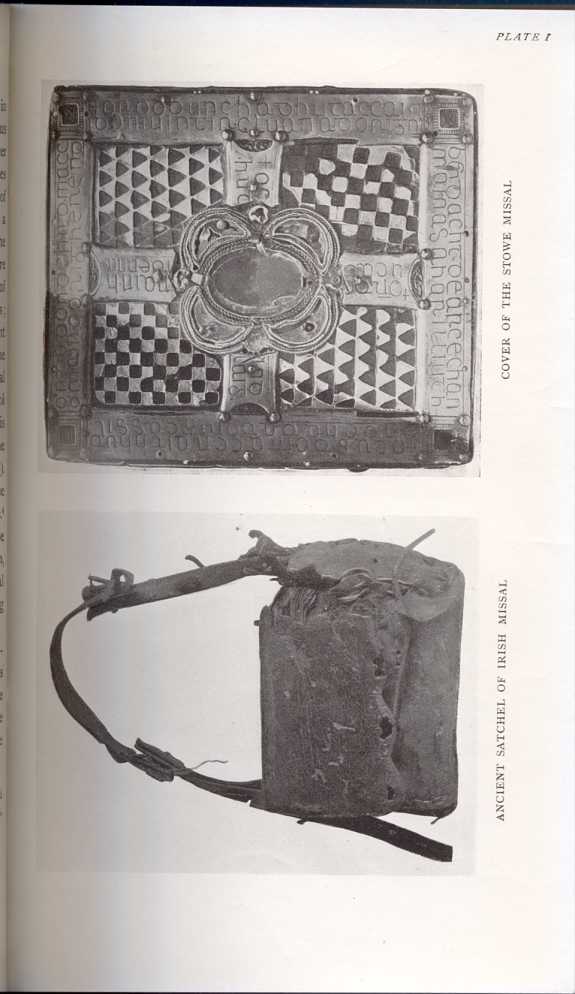 [Description: ANCIENT SATCHEL OF IRISH MISSAL
COVER OF THE STOWE MISSAL]
[Description: ANCIENT SATCHEL OF IRISH MISSAL
COVER OF THE STOWE MISSAL]
| CHAPTER I: INTRODUCTORY—THE USE OF BOOKS IN EARLY IRISH
MONASTERIES Old English libraries; the making, collection and use of books during the middle ages | |